
The spread of technology, trade, industry, and science have only reinforced the need for global policies and cross border research. The world is not moving inwards, it is expanding and a focus on collaboration and creating networks is becoming more important. Policymakers do not just impact the circumstances within their national or state borders, but their policies can impact neighboring countries and even trade partners from across the globe. It enhances the need for cooperation, and for collaborating with fellow policymakers across borders.
It requires unity, and bringing together organizations, creating international standards for sharing research, and collaborating on joint efforts to enhance the quality of the research. From acknowledgement to proactive participation, this cross border alliance can be implemented in numerous forms, to differing ends. Different challenges and issues require different solutions, but globally speaking, it is always more beneficial for authorities to link up with international bodies to have a more complete understanding of the obstacles ahead. Wider perspectives, joint resources, and more accessible research can serve to help in sectors from political and economic to climate and societal requirements.
How Collaboration Happens
Challenges to policies can be managed and resolved without the need to bring in international partners or foreign parties. But in the modern world, issues that demand policy change generally have impacts outside a country, on international trade partners, allies, and neighboring regions. It is a product of globalization, wide reaching technology and industry. Therefore, the need for cross border collaborations are only increasing, depending on the nature and reach of the obstacle.
There are many factors that can play a part in deciding on the best way to collaborate. Urgency, cost of resources, time frame to solve, and potential spread or leakage must be understood and communicated. The more urgent, costly, and potentially contagious the effect, the more attention it will attract. Problems that require long term solutions also impact international partners, and could require their contribution to find the best possible means to solve the challenges. So defining these criteria is really critical not just to the nation and nations facing the problems, but the countries which would be impacted, directly or indirectly, by the policies that come forth from the responses.
Forms of International Alliances
Alliances in policy research can be as flexible or as rigid as the impending issues require. The collabs that are perhaps easiest to manage, based on costs, time, and required resources, are simple information exchanges. Experts swap the insights via digital forums and private correspondence, linking up the academic or scientific research done in different countries. This can be enhanced significantly, right up to launching joint initiatives such as collaborative studies, publishing joint papers, and supporting the findings from the research partners.
At the highest level, there is a long term and more deeply rooted commitment. These are usually demanded when international crises or tremendous challenges arise, that are too voluminous or consuming for one nation to handle. Linking arms with neighbors, trade partners, and international allies, these allow for institutions to be set up, where the parties are dedicated to handling the problem behind a united banner. The institutions still recognize the individuality and autonomy of each contributor, to maintain their local identity, while contributing to a larger, global mission.
Shared Research and Insights
The most common form of alliance involves the simple but effective exchange of existing data and studies. It does not require long commitments or deliberating on courses of action to take next. This is a simple information exchange, that institutions can use to compare findings, frameworks, and methods used. For its speed, it is often one of the first methods that countries turn to in case of a sudden crisis or impact that requires urgent action to be taken.
Highly convenient, this can be managed quickly and without any extra cost or time consuming efforts by any of the parties involved. It gives each organization more clarity and tools to bolster their own methods. If the results are positive, it can lead to more frequent data sharing and even the creation of correspondence agencies or intermediaries, given longer term relationships. It starts with one-off or joint data sharing initiatives, which can open the doors to more deeply committed working relationships.
Joint Studies and Collaboration Efforts
Scenarios that demand more research or deeper analysis, especially those with cross border impacts, are more complex to solve in house. Research organizations and bodies can form partnerships with their international parties with the goal of tackling the problems together. They can distribute the tasks evenly, work simultaneously on the same studies for better comparison, or create relationships where each party works to its strengths. The idea is that there is a joint goal, and however the research and problem solving is balanced, all the researchers are working to that end goal.
It can end with joint publications, approved research documents from all parties, and potentially the establishment of institutions, if there is a potential for future collaborations. Joint studies involve researchers from multiple countries working under a single methodology to gather data simultaneously across different regions. It transcends simple data sharing, as this requires a common language and an organized path forward. At the end, this collaborative effort ensures that the resulting research is balanced and accounts for regional variances. Variances and overlooked details that a single nation study might overlook.
Institutional Cooperation
At the highest level, institutional cooperation involves the alignment of entire departments or think tanks to form a permanent international network. It is useful for the more layered and complex issues, which may require long term research to fully understand. It also establishes a solid intelligence sharing alliance between international partners, that can exceed the output of a single nation. Expanding a little further, these institutional cooperations can involve different methodologies and research practises. This can include dual degree programs between universities or shared administrative offices for a group of think tanks.
Such cooperation creates a seamless pipeline for information, ensuring that global research standards are upheld across all participating entities. It also builds a foundation for future collaborations. Given the challenges these alliances face, or their purposed design, they can be given authority to take their own action. The larger scale institutions have greater sway over their political allies, and can influence domestic policies, actions, and regulations.
Importance of Cross Border Cooperation
It is nearly impossible to ignore the positive impacts and benefits made from international research collaboration. It is the reason why these methods are so widespread, and why scientific and educational institutions create widespread networks, linking with their international counterparts. It creates a more globally accepted standard for these methods, strengthening the output by having more experts analyze and approve the methods used.
Besides reinforcing the methods and adding credibility, there are also the practicalities to observe here. The logistics and administrative costs can be distributed, sharing resources, delegating responsibilities and creating an effective workflow can reduce the overall time and currency costs of the projects. They are not as burdensome to one nation or regional organization. If an efficient relationship can be formed, it can unite experts cross borders to reach a shared goal. It can also incorporate alternative study methods, factoring in traditional research laboratories with workshops, think tanks, and public facing initiatives which can all contribute to the final result.
Strengthening Research Methods
By working with international peers, researchers are forced to defend their methodologies against a wider range of critiques. This external scrutiny ensures that research methods are robust, unbiased, and capable of producing results that are scientifically sound on a global stage. It effectively stress tests the logic of a study before it ever reaches the implementation phase.
They also give opportunities for trading and exchanging research methods. Researchers can compare the tools they use in their own applications against what their partners use, and work together to refine these strategies and methods.
Adding Credibility
A policy recommendation carries significantly more weight when it is backed by a coalition of international experts. It has first hand approvals, and more importantly, input from data scientists and experts from different backgrounds and schools of thought. This cross border consensus signals to governments that the findings are not merely the result of local political bias, but are grounded in a broader, objective truth.
The outcome is more widely accepted and therefore credible. This is important when policymakers turn to the public and release statements describing the studies and the course of action that it inspires.
Broadening Perspectives
Scientific information that is exposed to different legal systems, cultural norms, and economic conditions is more worldly and complete. It does not suffer from regional biases or isolated thought processes. Researchers gain a deeper understanding of how universal theories apply in diverse settings, leading to more nuanced and empathetic policy solutions.
This breadth of perspective is essential for creating policies that are inclusive and effective for a globalized population. Reaching these requires standardizing a common language and organizing responsibilities accordingly. This also introduces a new environment and outside the box thinking opportunities for the organizations involved.
Sharing Costs and Resources
The bigger and more widespread the problems, the more expensive they tend to be to study. Administrative costs include supporting massive data sets, the need for specialized equipment and experts, and the cost of additional resources. By extending the research to cross border organizations, the costs and resource usage can be significantly cut for all parties involved.
Cross border cooperation allows institutions to pool their financial resources and technical tools, making ambitious projects more affordable. By sharing the burden of high cost research, organizations can achieve breakthroughs that would be financially impossible if pursued alone. It also cuts down drastically on the cost of time that is needed to solve these problems independently.
Addressing Global Challenges
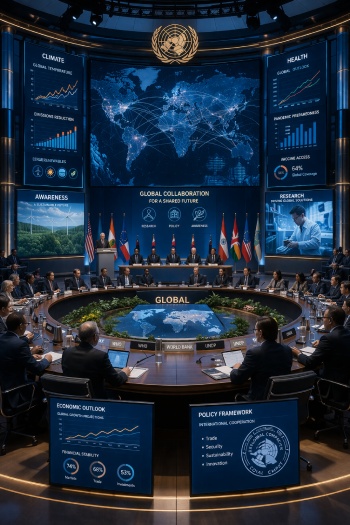
The more experts, teams of professionals, and institutions involved, the greater the output. The goals can be set higher, reaching global challenges that impact countries from around the world. The procedures are more drawn out and layered here, which is why heads of state and global leaders must first analyze the situations and explore a way forward that meets all their needs. The regulatory processes, parliamentary or congressional deliberation, and the application of the resulting studies into law vary from country to country.
That is why it is important to keep communication lines open, and leaders have a social responsibility to keep the public aware of any developments or procedures. These add clarity and prepare the general public for any changes or regulatory actions taken in the wake of the research done. There are global challenges that require uniform action, such as global financial crises, societal health issues, or environmental changes. Giving special priority to these, policymakers have even set up international organizations to tackle these problems, which form national alliances and create universal laws that allies must adhere to. It is all about using the internationally backed research and using it to make changes for the betterment of all.
Raising Public Awareness
Winning over the public with new research, methodologies, or courses of action directly linked to these is easier if the source of the information is globally approved. These are not political propaganda devices, nor actions that are inspired by limited scientific input. Instead, they have the backing of international scientific communities, and demand more credibility.
When a global network of universities and think tanks speaks with one voice on a topic like climate change or digital privacy, it creates a powerful narrative that is hard for the public or the press to ignore. This increased visibility is the first step toward driving the social change necessary for policy reform.
Forming International Institutions
Often, the successful collaboration between researchers leads to the birth of permanent international bodies. These range from institutions that reinforce the data correspondence for years to come, all the way up to the creation of independent international alliances and regulators. The latter can be given their own autonomy, given the acknowledgement and backing of their home nations and international organizations, and help to serve the allied countries.
These institutions serve as long term guardians of specific research fields, providing a stable platform for ongoing global dialogue. They act as a central nervous system for policy research, coordinating efforts across dozens of countries to ensure a unified approach to global crises.
Applying Research Internationally
The ultimate goal of cross border cooperation is the practical application of research in a way that benefits the entire world. When a policy solution is proven effective in one country through a collaborative study, it can be more easily adapted and scaled for others. This international application turns local successes into global standards, ensuring that the best ideas are shared and implemented wherever they are needed most.
Of course, each country has its own regulatory processes, authorities responsible for different disciplines and fields, and their own political motivations. However, even the most insular and isolated countries cannot ignore universally backed and accepted research, especially when it concerns immediate global issues. These organizations can go beyond sharing research and enlightening their partnered nations’ scientific bases. Given the magnitude of the problems they are designed to tackle, they can also have the authority to call for global summits, announce global threats or problems, and even appeal directly to the governments of countries.